Let's learn Japanese business etiquette. How to interact with superiors and people outside the company.

I wrote the article!

Japan Association for Construction Human Resources
Public Relations Department/Administration Department
Shohei Katayama
(Shohei Katayama)

Hello, this is Katayama from JAC (Japan Association for Construction Human Resources).
As you gain work experience in Japan, you will have more opportunities to talk with higher-ranking people and meet people outside the company.
In Japan, there is a culture where the way people speak and interact changes depending on their perspective.
Therefore, when interacting with people in higher positions or outside the company, it is important to know the unique Japanese business manners.
In this article, we introduce business etiquette that is useful when interacting with people in higher positions or outside the company.
We will also share how to cope when your heart becomes troubled by relationships with those in higher positions.
The unique structure of human relationships in Japan
In Japanese companies, the following types of people are considered to be in "superior positions":
- "Superiors" are those who hold a higher position than oneself (e.g., president, department head, section chief).
- Senior colleagues who joined the company earlier than me
I treat people in higher positions with respect and courtesy.
The priority order for determining one's position is "① Job title → ② Date of joining the company".
Even if someone joined the company later, if they hold a higher position than you, they are considered to be in a "higher position."
Furthermore, I treat people from outside my own company with respectful language and attitude, regardless of their position.
It's essential to treat people older than yourself with polite language and manners.
This article provides a detailed explanation of the characteristics of working styles in Japan, so please take a look.
An explanation of the characteristics of Japanese work styles! Are Japanese people really working too much?
Business etiquette when interacting with superiors or people outside the company
In Japan, when interacting with superiors or people outside your company, it's reassuring to be familiar with the rules regarding how to speak and where to sit.
How to address someone
When addressing someone, you generally add "san" to their name.
People with a title are addressed by their name followed by their title.
Calling someone by their first name alone can be considered rude, so be careful.
However, the rules for how to address someone may differ from the examples above, depending on the industry or company.
Therefore, check with your senior colleagues or others at work to see the rules of how to address each other, and follow the industry and company rules.
How to communicate
There are polite phrases you can use when asking for something or declining something.
While it's not strictly necessary to use it, adding it at the beginning of a sentence can express your consideration for the other person.
[Examples of when making a request]
For example, if you want someone to review a document, try using the following phrasing:
[Examples of how to decline]
For example, when declining someone's invitation, try using the following expressions:
bow
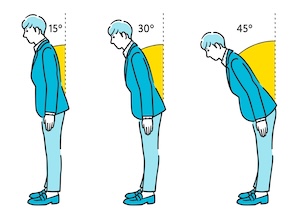
In Japan, we bow when we greet someone.
The meaning of a bow varies depending on the angle at which you lower your head.
- 15°: When you normally greet someone
- 30°: When greeting someone for the first time, or when expressing gratitude.
- 45°: When apologizing
business card exchange
When meeting someone from outside the company for the first time, it's common to exchange business cards.
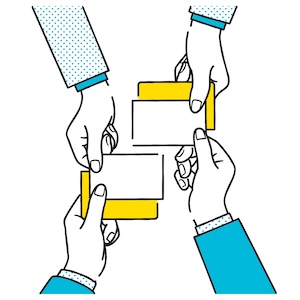
The process for exchanging business cards is as follows:
- Stand and face your opponent
- Offer your business card with both hands.
- Tell them your company name and your name.
- Receive the other person's business card
The basic rule is to receive someone's business card with both hands.
However, if the act of handing over a business card and the act of receiving a business card occur at the same time, it is not possible to receive it with both hands.
At that time, you offer your business card with your right hand while receiving the other person's business card with your left hand.
There are certain manners to follow when handling business cards you receive.
- Place the received business card on the desk or in your business card holder.
- Do not fold or dirty business cards.
- Don't write notes on business cards.
Place to sit
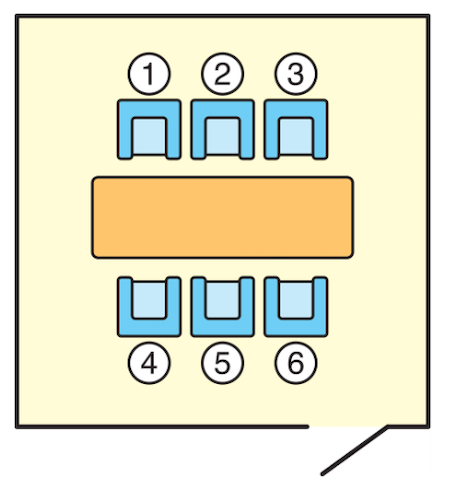
In Japan, there are rules about where you should sit in rooms and on public transport.
The seat where the person of highest rank sits is called the "upper seat," and the seat where the person of lower rank sits is called the "lower seat."
Basically, you can remember it as follows:
- The seat furthest from the entrance: This is where the person in the highest position sits.
- The seat closest to the entrance: This is where the person with the lowest rank sits.
When riding in a taxi, the person with the highest rank sits in the seat behind the driver.
Even Japanese people sometimes get the seating arrangement wrong.
If you're unsure, it's perfectly fine to ask the people around you, "Where should I sit?"
Business dinners and entertaining clients
There are manners to observe when dining with superiors or people from outside the company.
Remember these three points.
- Please follow the rules regarding seating arrangements (upper and lower seats).
- When toasting, hold your glass lower than the person of higher status.
- You should start eating only after the person in the higher position has begun.
phone
When making a phone call to someone in a higher position or someone outside the company, you should start by greeting them and stating your company name and your own name.
[会社名(かいしゃめい)] の [自分の名前(じぶんのなまえ)] です。
If the person who answers the phone is not the person you want to talk to, try asking the following:
Always add "sama" (様) to the other person's name.
When ending a phone call, hang up after the other person.
How to cope when you feel emotionally distressed in a relationship with someone in a superior position.

If someone in a higher position says harsh words or makes you do unreasonable work, and your heart aches, don't endure it alone.
Try consulting with your company's HR department or the consultation desk or representative.
If you cannot consult with the internal HR department, contact points, or representatives, you can also rely on external specialized organizations.
For example, there are services that allow you to consult about work concerns in foreign languages.
Comprehensive Labor Consultation Corner (Foreign Language Support)
Registered Support Organizations and other sources are also available for consultation.
Additionally, Specified Skilled Workers in the construction sector can use FITS' (Foundation for International Transfer of Skills and Knowledge in Construction) "Native Language Consultation Hotline."
Native Language Consultation Hotline
Summary: Study Japanese business etiquette to build good relationships with superiors and people outside your company.
Japanese business etiquette may seem difficult at first.
But there's no need to worry.
If you have the intention to treat others with polite words and actions, your respect will be properly conveyed to them.
There are many business manners to learn, such as how to address someone, bowing, exchanging business cards, and where to sit, but let's learn them little by little!
If you encounter a problem in your relationship with someone in a higher position that you cannot resolve on your own, please do not push yourself too hard.
You should seek help from your company's consultation desk or from a "General Labor Consultation Corner" that offers consultations in foreign languages.
About us, JAC
JAC(Japan Association for Construction Human Resources)is an organization that supports all Specified Skilled Workers working in the Japan construction industry. We work with companies that accept Specified Skilled Workers to create a work environment that is easy for everyone to work in.
We're also taking the exams you need to become a Specified Skilled Workers!
And JAC has received many requests for job offers from companies that want Specified Skilled Workers to work for.
Specified Skilled Workers Wanted! Job Listings
For those of you who want to work in Japan using Specified Skills, we are introducing jobs that match your occupation and aspirations!
If you have any problems, please feel free to contact us!