A detailed introduction to the different types of currency in Japan! Check out how to pay with money

I wrote the article!

Japan Association for Construction Human Resources
Chief of Research and Development Department / Administration Department / Public Relations Department
Motoko Kano
(Kano Motoko)
Hello, this is Kano from JAC (Japan Association for Construction Human Resources).
There are many different types of money in Japan.
Therefore, some people may not know which money to pay when paying.
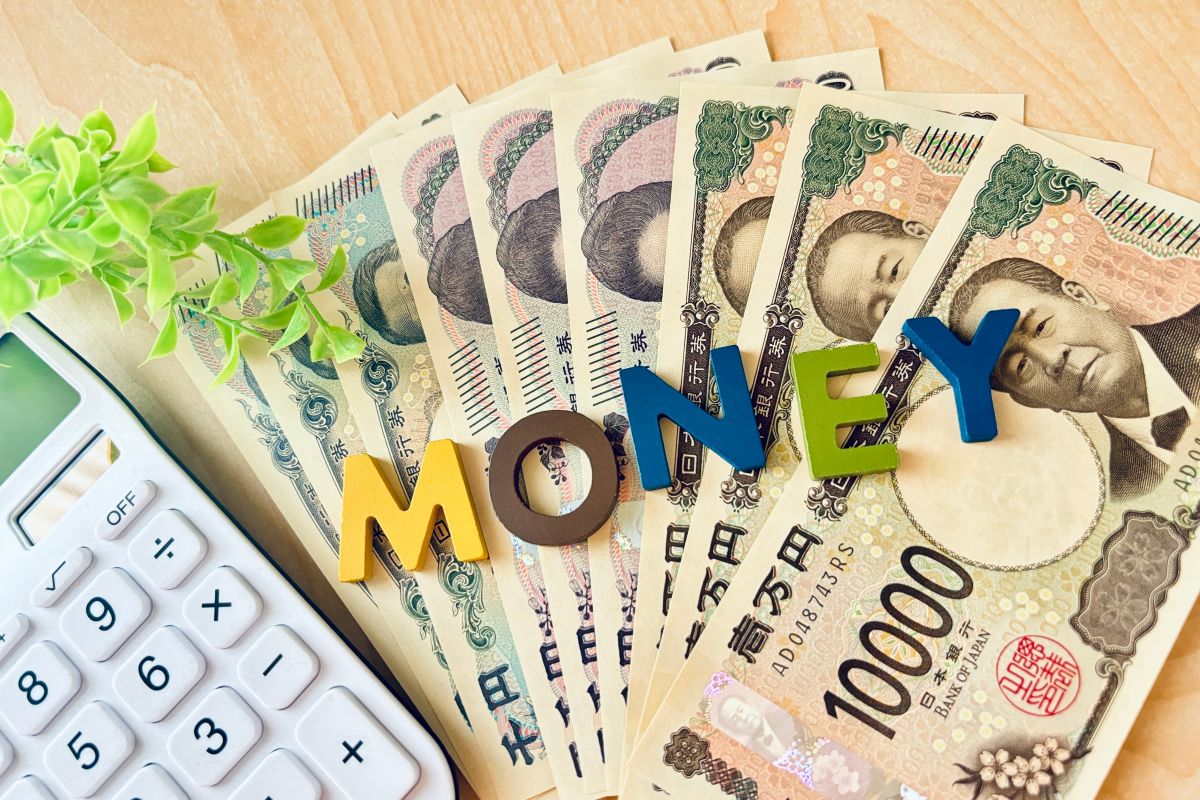
This time, I will introduce Japan's money with photos.
We will also explain the most commonly used payment methods in Japan, so be sure to read to the end.
What types of currency are there in Japan?
The currency used in Japan is called the yen.
It may also be written with the symbol "¥".
Numbers may be expressed in Chinese numerals.
(example:¥100 → 百円)
Japanese currency can be broadly divided into two types.
One is "banknotes" made of paper, and the other is "coins" made of metal.
Types and Units of Japanese Paper Money (Banknotes)
Money made from paper is called "banknotes."
New banknote designs will be used from July 2024, but the old banknote designs will still be valid.
There are four types of Japanese banknotes
There are four types of Japanese banknotes:
- 1,000 yen bill
- 2,000 yen bill
- 5,000 yen bill
- 10,000 yen bill
Each banknote is explained with a photo.
1,000 yen bill
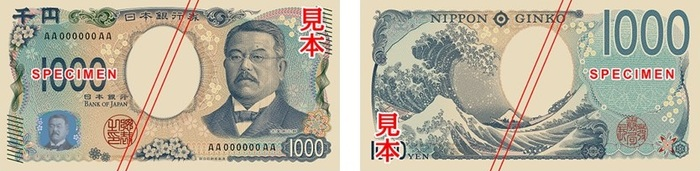
▼New design
▼Old design
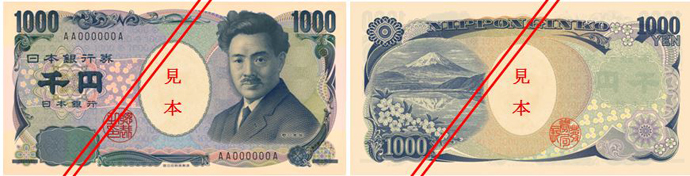
Source: National Printing Bureau website Basic information on banknotes
The 1,000 yen note is the most frequently used denomination.
The new design of the 1,000 yen note features bacteriologist Shibasaburo Kitasato.
He is known worldwide for his research on tetanus bacteria and made a significant contribution to the development of medicine in Japan.
The old design of the 1,000 yen note features another bacteriologist, Hideyo Noguchi.
2,000 yen bill
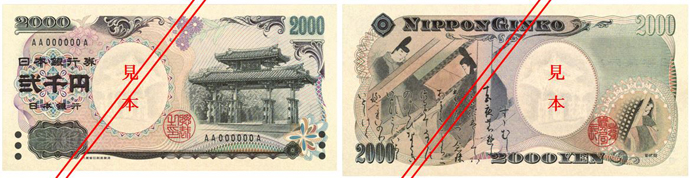
Source: National Printing Bureau website Basic information on banknotes
The 2,000 yen note is a special banknote that was produced between 2000 and 2003.
As of 2025, this banknote is rarely seen.
The obverse features a famous Okinawan landmark, Shureimon Gate of Shuri Castle.
Please be aware that it may not be usable at automatic payment machines, vending machines, ticket vending machines, etc.
5,000 yen bill
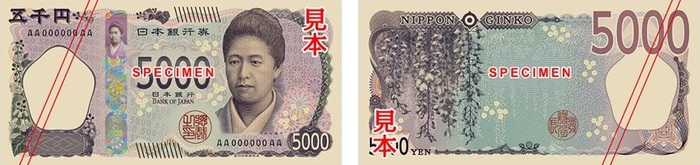
▼New design
▼Old design
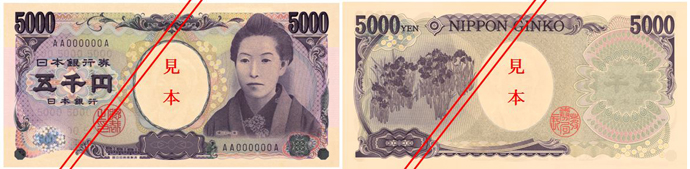
Source: National Printing Bureau website Basic information on banknotes
The new design of the 5,000 yen note features Tsuda Umeko, an educator who founded an English school for girls in Japan.
The old design of the 5,000 yen note features Higuchi Ichiyo, a writer active around 1890.
10,000 yen bill
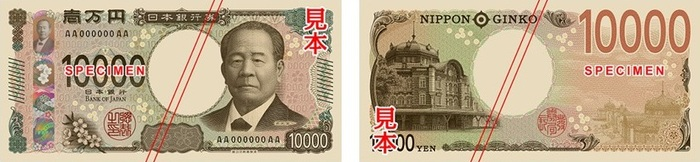
▼New design
▼Old design
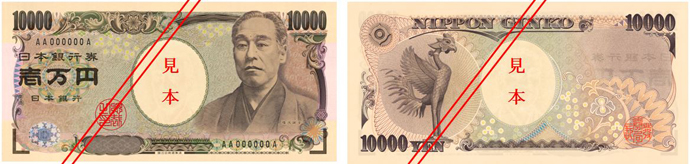
Source: National Printing Bureau website Basic information on banknotes
The 10,000 yen note is the highest denomination banknote in Japan.
The new design of the 10,000 yen note features businessman Eiichi Shibusawa.
He founded many companies and banks in Japan and is also known as the "father of Japanese capitalism."
The old design of the 10,000 yen note features the scholar and educator Yukichi Fukuzawa.
The innovations behind Japanese banknotes
Japanese banknotes have two features to prevent counterfeiting.
Slits
If you hold the bill up to a bright spot, you can faintly see people's faces.
3D hologram
A hologram is a shiny object whose pattern changes when viewed from different angles.
The new banknotes feature a "3D hologram" depicting a person.
A distinctive feature of this work is that when you change the angle, the person appears to move.
Types and Units of Japanese Metal Coins
Metal money is called "coins."
There are six types of Japanese coins
There are six types of Japanese coins:
- 1 yen coin
- 5 yen coin
- 10 yen coin
- 50 yen coin
- 100 yen coin
- 500 yen coin
Each coin is explained with a photo.
1 yen coin
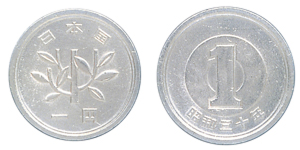
Source: List of Regular Currency: Ministry of Finance
The 1 yen coin is the smallest coin in Japan.
It is very light, measuring 20.0 mm in diameter and weighing just 1 g.
The front side features a young tree and the back side features the number "1".
5 yen coin
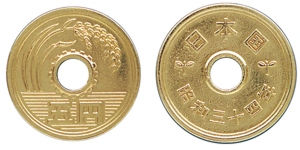
Source: List of Regular Currency: Ministry of Finance
The 5 yen coin is a gold coin with a hole in the center.
The size is 22.0 mm in diameter and weighs 3.75 g.
The surface is decorated with images of rice ears, gears, and water.
The back side features a design of two leaves.
10 yen coin
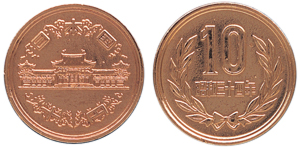
Source: List of Regular Currency: Ministry of Finance
The 10 yen coin is a copper-colored coin.
It measures 23.5mm in diameter and weighs 4.5g.
The obverse features a depiction of the Phoenix Hall of Byodoin Temple, a historic building in Kyoto, and arabesque patterns.
The reverse features an evergreen tree and the number "10."
50 yen coin
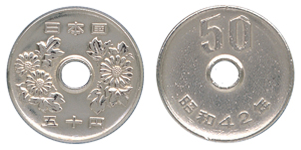
Source: List of Regular Currency: Ministry of Finance
The 50 yen coin is a silver coin with a hole in the center.
The size is 21.0 mm in diameter and weighs 4.0 g.
The front features a chrysanthemum flower and the back features the number "50."
The chrysanthemum flower is Japan's national flower.
100 yen coin
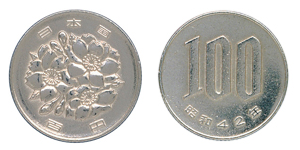
Source: List of Regular Currency: Ministry of Finance
The 100 yen coin is silver and slightly larger than the 50 yen coin.
It measures 22.6mm in diameter and weighs 4.8g.
The front side features cherry blossoms, a symbol of Japan, and the back side features the number "100."
500 yen coin
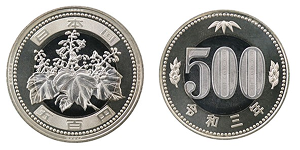
Source: List of Regular Currency: Ministry of Finance
The 500 yen coin is the highest denomination coin in Japan.
It has a diameter of 26.5mm and weighs 7.1g.
It is the largest of all Japanese coins in terms of both size and weight.
The front side features a paulownia crest, and the back side features bamboo, tachibana, and the number "500."
The design has been changed three times to prevent counterfeiting.
- Issued in 1982: Silver
- Published in 2000: Gold
- Issued in 2021: Two-tone with gold edges and silver center
The previous design of 500 yen coins can also be used.
Special coins
In addition to the regular coins introduced above, there are also coins with special designs.
It may not be accepted at some stores, so please check before using it.
Coins are often used on buses and trains.
Please refer to the following column for how to ride.
Don't know how to ride a Japanese bus? Check out how to get on and off, and etiquette
Don't know how to ride Japanese trains? Learn how to buy tickets and the process
Introducing the types of payment methods commonly used in Japan
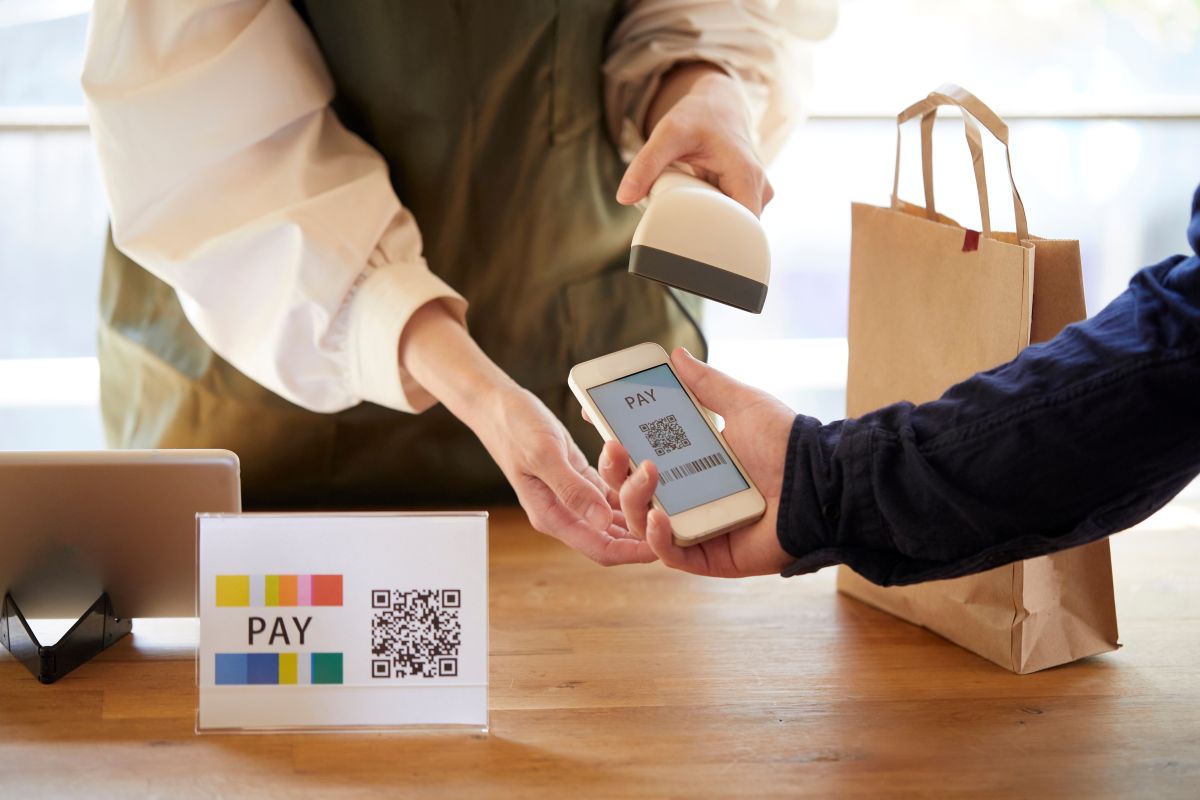
When shopping in Japan, there are a variety of ways to pay.
Here are the main methods.
Cash payment
You pay using notes and coins.
There are trays at the register.
When paying, place your money on the tray.
Also, when paying with paper money, it is polite to keep the bills facing the same direction.
Electronic money and smartphone payments
This is a way to pay using a card or smartphone.
Transportation IC cards
This card is convenient when riding trains and buses.
"Suica" and "PASMO" are famous.
IC cards are used by charging money.
You can charge money to your IC card at a ticket vending machine at a station or at a konbini.
If you charge your money, you can use public transportation just by holding up your card.
Some stores, such as konbini, can also be used to purchase products.
It is convenient to always charge your money.
Smartphone payment
This is a method of payment using a smartphone.
You can use a dedicated app on your smartphone to link it with a Japanese bank account or deposit money with a konbini.
In Japan, "PayPay" and "Rakuten Pay" are commonly used.
You can pay by scanning the QR code at the store's cash register with your smartphone or by holding your smartphone screen over the machine.
Credit card
This card allows you to pay later for goods and services.
When paying, you will present your credit card, sign, and enter your PIN.
It can be used in many stores in Japan.
However, to apply for a credit card in Japan, you will need to undergo an application process.
It is difficult to get a credit card immediately after coming to Japan.
In Japan, there are some stores that do not accept electronic money or credit cards.
Especially in smaller or older stores, cash may be the only option.
It's a good idea to carry cash as well as electronic money, smartphone payments, and credit cards.
Also, there is no tipping culture in Japan.
At restaurants and in taxis, pay only the displayed amount.
Summary: There are two types of currency in Japan: banknotes and coins
The currency of Japan is the yen.
There are two types of money: paper money (banknotes) and metal money (coins).
Banknotes come in denominations of 1,000 yen, 2,000 yen, 5,000 yen, and 10,000 yen.
The coin denominations are 1 yen, 5 yen, 10 yen, 50 yen, 100 yen, and 500 yen.
The designs of banknotes and coins are sometimes changed, but banknotes and coins issued in the past can still be used.
When paying in Japan, you can pay with cash using banknotes and coins, electronic money, smartphone payments, or credit cards.
Some stores do not accept electronic money, smartphone payments, or credit cards, so it is best to carry cash with you.
About us, JAC
JAC(Japan Association for Construction Human Resources)is an organization that supports all Specified Skilled Workers working in the Japan construction industry. We work with companies that accept Specified Skilled Workers to create a work environment that is easy for everyone to work in.
We're also taking the exams you need to become a Specified Skilled Workers!
And JAC has received many requests for job offers from companies that want Specified Skilled Workers to work for.
Specified Skilled Workers Wanted! Job Listings
For those of you who want to work in Japan using Specified Skills, we are introducing jobs that match your occupation and aspirations!
If you have any problems, please feel free to contact us!